Improving customer experience begins with highly specific touchpoints in daily operations
In customer experience management, organizations are often drawn to major concepts such as CX strategy, digital transformation, personalization, artificial intelligence, or customer relationship management systems. However, from the customer’s perspective, experience is not perceived through strategic documents, organizational charts, or slogans displayed in the office.
Customers experience an organization through highly specific details:
- Whether a phone call is answered promptly.
- Whether eye contact conveys genuine attention.
- Whether a greeting creates a sense of welcome.
- Whether a request is followed through to completion.
- Whether an incident is handled with a strong sense of responsibility.
These are customer touchpoints: every moment at which customers directly or indirectly interact with an organization’s people, processes, physical environment, technology, products, and brand. Each touchpoint may appear minor. Yet the accumulation of dozens, or even hundreds, of touchpoints ultimately shapes the customer’s perception of the organization as a whole.
Therefore, improving customer experience does not necessarily have to begin with a large-scale project. Organizations can start with five small actions that are capable of generating noticeable improvements in how customers feel.
.png)
1. Proactively Recognize the Customer
One of the earliest and most influential touchpoints is the feeling: “I have been seen.”
A guest enters a hotel, yet employees continue talking among themselves. A patient arrives at the reception desk, but no one proactively offers assistance. A banking customer waits while employees remain focused on their screens. A phone call comes in, but the receiver responds mechanically without paying genuine attention to the need behind the question. In such situations, the organization may have followed the required procedure, yet the customer still feels overlooked.
“Seeing the customer” does not simply mean looking at them. It refers to the ability to recognize the customer’s presence, emotional state, and unspoken needs.
Frontline employees need to be trained to:
- Proactively establish eye contact;
- Observe signs of confusion, anxiety, urgency, or dissatisfaction;
- Identify customers who need assistance before they have to ask;
- Pause internal tasks in order to prioritize the customer’s presence.
In Lead-UP Academy’s programs, particularly in high-contact sectors such as hospitality, healthcare, and banking, observation skills are always positioned before communication skills. An employee can only deliver appropriate service when they genuinely recognize the customer’s emotional and situational state.
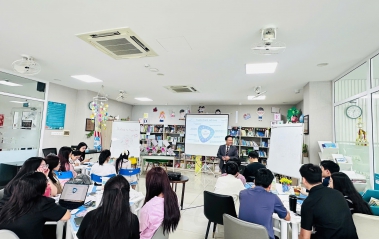
At Viet An Eye Hospital in Da Nang, the “Excellence in Customer Experience Management” program was specifically designed for doctors, nurses, technicians, and frontline employees, with close attention to the psychological characteristics of patients and their family members in a healthcare environment. In this context, a reassuring look, a timely guiding gesture, or proactive support for an elderly patient may be as valuable as a lengthy explanation.
2. Listen with Empathy, Not Merely to Respond
Many organizations believe that their employees already possess listening skills. In practice, however, many service interactions remain limited to listening for information and preparing a response, rather than listening to understand the customer’s experience, emotions, and genuine needs.
When a customer says, “I have been waiting for quite a long time,” they may need more than information about the processing time. At a deeper level, they may expect the organization to recognize and acknowledge the inconvenience caused by the delay.
When a customer says, “Your price is higher than elsewhere,” this is not necessarily a rejection. Behind the comment may be a need for a clearer explanation of the value, quality, or differentiation the organization provides.
Similarly, when a patient repeatedly asks the same question, the reason may not be a lack of understanding. They may be anxious, uncertain, or in need of additional reassurance before making a decision.
Effective listening therefore needs to occur simultaneously at three levels:
- Listening to content: What is the customer saying?
- Listening to emotion: How is the customer feeling?
- Listening to need: What does the customer truly want?
In the program developed for TPBank Da Nang, Lead-UP Academy designed the module “Communication Skills and Customer Complaint Handling” based on training-needs analysis, learner surveys, mystery-customer activities, and the practical requirements of the organization.
This approach reflects an important principle: organizations cannot improve the quality of customer touchpoints merely by providing employees with a set of pre-prepared responses. Employees need to understand the situation accurately, recognize the emotions and needs behind the customer’s words, and then select an appropriate response. In service, a technically correct answer delivered without empathy can still create a poor experience.
.png)
[Photo: Training Program at Paddington Hotel Halong Bayview]
3. Communicate Clearly and Manage Expectations
Many negative experiences do not originate from product quality or professional competence, but from the organization’s failure to manage customer expectations effectively.
- Customers do not know how long they will have to wait.
- They do not know what the next step is.
- They do not know who is responsible.
- They do not know when they will receive a response.
- They do not know whether their issue has been acknowledged.
Customers often fill information gaps with assumptions. When uncertainty arises, the actual waiting time feels longer, and minor errors are more likely to be perceived as serious failures.
Clear communication at a touchpoint should answer at least four questions:
- What is currently being done?
- Who is responsible?
- What is the expected timeframe?
- What does the customer need to do next?
In a hotel, guests need to know when their room will be ready or when an additional request will be fulfilled. In a hospital, patients need clear guidance on the examination sequence, waiting time, and location of the next step. In a bank, customers need to understand which documents are still missing, the current status of the transaction, and when the result will be available.
At BIDV Bac Quang Binh, Lead-UP Academy’s “Sales Skills and Relationship-Building” program was designed not only to strengthen sales capabilities, but also to transform advisory mindsets and behaviors in a context where customers increasingly expect a higher-quality experience. Clear consultation helps customers make decisions. Effective expectation management helps customers feel secure. Both are essential foundations for building trust.
4. Proactively Take One Small Extra Step
A good experience often results from an organization fulfilling its commitments correctly. A memorable experience, however, often emerges when employees proactively take one small step beyond the minimum requirement.
This may include:
- Proactively guiding the customer instead of merely pointing;
- Rechecking information before the customer has to ask;
- Reminding the customer of an important detail;
- Helping connect the customer with the next department;
- Calling back to confirm that the issue has been resolved;
- Remembering a customer’s special need;
- Suggesting a more convenient option.
These actions do not necessarily involve significant additional cost, yet they can create a strong and visible sense of care. In the project at Paddington Hotel Halong Bayview, Lead-UP Academy implemented a multi-layered program for senior leaders, managers, frontline employees, and support functions, rather than focusing on only one employee group.
This approach reflects the reality that customer experience is not created solely by employees who interact directly with customers. A guest request may pass through reception, housekeeping, food and beverage, engineering, security, and support functions. If only one link in the chain lacks initiative, the entire experience can be disrupted. Therefore, “taking one small extra step” should become a shared organizational behavior rather than depend solely on the enthusiasm of a few outstanding individuals.
.png)
[Photo: Training Program at Viet An Eye Hospital, Da Nang]
5. Follow Through Until the Customer Actually Receives the Result
A common operational error occurs when employees assume that their responsibility ends once they have passed the information to someone else.
- “I have informed the relevant department.”
- “I have already forwarded the request.”
- “That is not handled by my department.”
- “Please contact another department.”
Internally, the employee may have completed a task. From the customer’s perspective, however, the issue remains unresolved. Customers are not concerned with how many departments an organization has. They recognize only one brand. Therefore, the experience is only complete when the customer’s need has been addressed or when the customer has received a clear course of action.
A follow-through mindset includes:
- Confirming that the request has been received;
- Transferring complete information to the correct person;
- Monitoring the handling process;
- Proactively updating the customer;
- Rechecking satisfaction after completion.
Following the training series at Paddington Hotel Halong Bayview, Lead-UP Academy and the hotel continued with the emulation campaign “Happiness Begins from the Heart,” designed to transfer training content into daily operations rather than allowing the program to end in the classroom.
This also reflects Lead-UP Academy’s consistent philosophy: the value of training is not measured by the number of learning hours or the level of enthusiasm in the classroom, but by behavioral change and practical results.
Lead-UP defines its mission as partnering with organizations to solve specific business problems, optimize resources, and improve operational performance through management consulting, operational consulting, and practice-based in-house training.
From “Touchpoints” to an “Experience System”
The five actions above can be performed by individual employees. However, to maintain a consistent customer experience, organizations cannot rely solely on spontaneous personal awareness. An effective customer experience system requires at least five components:
- First, identify the customer journey. The organization needs to determine the stages customers go through, from initial research and contact to purchase, service usage, and post-purchase interaction.
- Second, identify the critical touchpoints. Not all touchpoints have the same level of influence. Organizations should focus on the “moments of truth” that are most likely to shape customer perceptions.
- Third, standardize behaviors and processes. Requirements related to greetings, response times, handovers, complaint handling, and post-service follow-up need to be translated into SOPs, checklists, and specific standards.
- Fourth, train through real-life situations. Capabilities such as empathy, communication, consultation, and complaint handling cannot be developed through lectures alone. Learners need to participate in role-plays, analyze situations, and receive feedback.
- Fifth, measure and continuously improve. Organizations need to monitor customer feedback, service failures, handling time, compliance levels, and improvement outcomes at each touchpoint.
In Lead-UP Academy’s projects, the partnership process does not usually begin with a pre-existing curriculum. Instead, it begins with on-site surveys, service-quality assessments, journey analysis, pain-point identification, and the design of programs tailored to each target group.
At Paddington Hotel Halong Bayview, the project began with a multi-channel service-quality assessment before the training and operational transformation phases were implemented. In the banking sector, Lead-UP Academy also approaches CX as a system that must be operationalized, measured, and scalable, rather than as a short-term inspirational program.
.png)
[Photo: Training Program at TPBank]
Customer Experience Begins with Employee Experience
Organizations cannot expect employees to create positive customer experiences while those employees are working in a system characterized by poor coordination, insufficient information, limited autonomy, or the constant need to resolve the consequences of internal errors.
Therefore, improving external touchpoints must go hand in hand with improving internal touchpoints.
- A receptionist can only communicate clearly with customers when accurate information is received from other departments.
- A bank teller can only process transactions quickly when internal procedures are designed effectively.
- A nurse can only provide attentive care when workload, movement flows, and coordination mechanisms are organized systematically.
During the program implemented for the support and office functions at Paddington Hotel Halong Bayview, Lead-UP Academy emphasized a key principle: excellent customer experience must be built on the foundation of employee experience and the quality of internal coordination. Customer experience management is therefore not merely the responsibility of the customer service department. It is an integrated management challenge involving: Strategy – People – Culture – Processes – Technology – Data – and Operational Management Capability.
Conclusion
Customers may not remember everything an organization says. However, they often remember for a long time how the organization made them feel during each interaction.
- Proactive eye contact.
- A timely question.
- A clear explanation.
- One more step of support than expected.
- A commitment followed through to completion.
These are all small actions. Yet when they are performed correctly, consistently, and in a coordinated manner, they become touchpoints that build trust, satisfaction, and loyalty.
When these small actions are transformed into shared standards across the organization, the business does more than improve service. It gradually builds a sustainable customer experience capability.
---
Lead-UP Academy | Learn to Act – Act to Lead

 VI
VI EN
EN