Proposed Action Recommendations for Vietnamese Enterprises Based on the AI Index Report 2025

Among the numerous AI index reports released in 2025, the AI Index Report 2025 by Stanford HAI stands out as one of the most comprehensive and insightful publications. Its breadth and depth provide a holistic view of AI’s development trajectory over the past year. This eighth edition—the most extensive to date—paints a panoramic picture of 2024, a pivotal year in which AI transitioned from a subject of technological curiosity to a genuine economic and scientific driving force.

Below are four key pillars distilled from the report, analyzed through the expert lens of Lead-UP Academy.

1. The Economic Paradox of AI: Surging Training Costs vs. Rapidly Declining Usage Costs

One of the most significant economic insights from the past year is the growing cost polarization within the AI ecosystem.

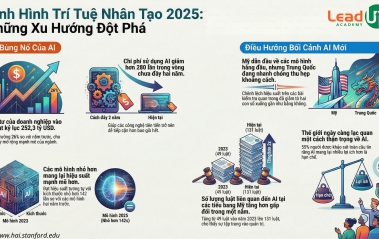
  • Rising barriers to entry: The development of frontier models is increasingly becoming an exclusive domain of a small number of financially powerful technology giants. Training costs have risen exponentially: while GPT-4 (2023) reportedly cost approximately USD 79 million to train, Llama 3.1-405B (2024) is estimated to require around USD 170 million. The computational resources needed to train state-of-the-art models are doubling approximately every five months.
  • Democratization of AI usage: In contrast, inference costs for end users have fallen dramatically. The cost of querying a model with GPT-3.5-level performance has decreased by more than 280 times within just 18 months (from November 2022 to October 2024).
  • Implication: This dynamic has created an ecosystem in which AI development is increasingly concentrated among a small number of companies—predominantly based in the United States—while AI adoption is rapidly expanding worldwide at ever-lower costs.

2. AI Geopolitics: The United States Leads in Quality, China Dominates in Scale

The 2025 report highlights the intensifying competition between the two major technological powers:

  • The position of the United States: The U.S. continues to lead in producing breakthrough AI models. In 2024, 40 notable AI models originated in the U.S., compared to 15 in China and only 3 in Europe. Private investment in AI in the U.S. reached USD 109.1 billion—nearly twelve times that of China.
  • China’s rapid ascent: Despite lower investment levels, China is closing the technical performance gap at remarkable speed. Performance differences on benchmark tests such as MMLU between U.S. and Chinese models have narrowed from double-digit margins in 2023 to near parity in 2024. Moreover, China leads the world in AI patent filings (accounting for 69.7% globally) and dominates industrial robotics, installing more robots than the rest of the world combined.

3. Performance Convergence and the Rise of Open-Source Models

The year 2024 marked a blurring of boundaries between closed models (e.g., GPT-4) and open-weight models (e.g., Llama 3).

  • A vanishing performance gap: At the beginning of 2024, the best closed models outperformed the best open models by approximately 8%. By February 2025, this gap had narrowed to just 1.7%, demonstrating the extraordinary pace at which the open-source community is catching up with proprietary innovation.
  • Emerging reasoning capabilities: The field is witnessing a shift from models that merely “predict the next token” toward models capable of structured reasoning (such as OpenAI’s o1). These models leverage test-time compute to solve complex problems, achieving significantly improved performance in mathematics and scientific reasoning tasks.

4. The “Dark Side” of Progress: Safety Gaps and Escalating Risks

While technical capabilities have advanced rapidly, AI governance and safety mechanisms are lagging behind:

  • Lack of standardization: Despite a 56.4% increase in AI-related incidents in 2024, the industry still lacks unified standards for evaluating Responsible AI practices.
  • Bias and data constraints: AI models continue to exhibit implicit biases, even when explicitly trained to avoid them. In addition, publicly available data sources are becoming increasingly scarce and restricted, forcing developers to rely more heavily on synthetic data—raising new concerns about data quality and reliability.
  • Environmental impact: Intelligence comes at an energy cost. The carbon emissions associated with training large models such as GPT-4 or Llama 3.1 have increased by several orders of magnitude compared to early models like AlexNet.

Conclusion: From Future Technology to Present Reality

The AI Index Report 2025 clearly demonstrates that AI is no longer a technology of the future—it is a defining reality of the present. The year 2024 marked a phase in which AI permeated nearly every domain: from winning Nobel Prizes in science, to receiving FDA approval in hundreds of medical devices, to being adopted by 78% of enterprises worldwide.

However, this rapid progress is accompanied by a growing concentration of power within the industrial sector (which accounts for 90% of notable AI models) and an escalation of social risks that remain insufficiently governed. The central challenge of 2025 is no longer “What can AI do?” but rather “How can AI be governed effectively, safely, and equitably?” - especially as the gap between technological capability and regulatory frameworks continues to widen.

5. Action Implications for Vietnamese Enterprises

Insights from the AI Index Report 2025 suggest that the core challenge for Vietnamese enterprises is no longer whether AI is accessible, but how AI is strategically integrated and governed within organizational operations.

  • First, organizations must move beyond fragmented AI experiments toward a coherent AI operating strategy. As the development of frontier models becomes increasingly concentrated among a few global technology giants, competitive advantage for Vietnamese firms lies not in building AI from scratch, but in embedding AI into decision-making processes and operational systems. AI should be treated as an integral component of the operating model, explicitly linked to productivity, quality, and responsiveness.
  • Second, AI adoption should prioritize internal productivity enhancement rather than surface-level automation alone. The AI Index Report highlights AI’s growing role as an economic driver, yet its most impactful applications often lie in improving everyday operations—reducing manual workload, shortening process cycles, enhancing transparency, and strengthening cross-functional coordination. For Vietnamese enterprises, these use cases offer practical, scalable, and measurable value.
  • Third, technological deployment must be accompanied by systematic investment in human capability development. As performance differences between AI models continue to converge, organizational advantage increasingly depends on how effectively people use AI. AI literacy—understanding how AI works, where it fails, and how to frame the right questions—should be recognized as a new managerial competence. AI delivers value not by replacing human judgment, but by augmenting it within daily workflows.
  • Fourth, enterprises should adopt a flexible AI ecosystem approach, combining commercial AI solutions with open-source models. The narrowing performance gap between proprietary and open models presents significant opportunities for organizations with limited resources. A diversified technology portfolio not only optimizes costs, but also reduces vendor lock-in and enhances adaptability to local business contexts.
  • Finally, AI governance must precede large-scale AI adoption. With AI-related risks and social implications rising faster than regulatory frameworks, enterprises cannot rely solely on external regulation. Proactively defining ethical principles, decision boundaries, and risk controls for AI use is essential to building organizational trust and long-term legitimacy.

In essence, the AI Index Report 2025 underscores a fundamental shift: AI is no longer a question of technological capability, but of managerial capability. Success will belong to organizations that can operate AI wisely, responsibly, and in alignment with real business value.

For the full AI Index Report 2025 by Stanford HAI, please refer to the original publication at:
https://hai.stanford.edu/assets/files/hai_ai_index_report_2025.pdf

Wishing you great success!

---

Lead-UP Academy | Learn to Act – Act to Lead

icon contact

0905154949

Gọi ngay cho chúng tôi

icon contact

Zalo

(8h00- 22h00)

icon contact

Facebook

(8h00- 22h00)

icon-contact phone icon-contact zalo icon-contact facebook