
 VI
VI EN
EN





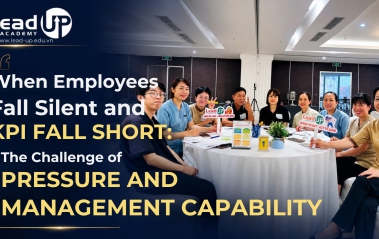
When Employees Fall Silent and KPIs Fall Short: The Challenge of Pressure and Management Capability
In business management, certain signs may appear unrelated on the surface but, in reality, reflect the same systemic issue. A team that is becoming increasingly less willing to debate in meetings and a team that consistently fails to meet its KPIs may be two manifestations of the same management gap: managers have not accurately identified the factors constraining performance and have not created an environment in which real problems can be openly discussed.
Do employees leave because of the company or their manager?
Employee turnover is not merely an issue for the Human Resources department. From the perspective of business operations management, every employee departure can generate a series of consequences: workflow disruption, loss of organizational knowledge, increased pressure on remaining employees, additional recruitment and training costs, and a direct impact on the quality of customer service.
05 Small Actions That “Touch” the Customer
In customer experience management, organizations are often drawn to major concepts such as CX strategy, digital transformation, personalization, artificial intelligence, or customer relationship management systems. However, from the customer’s perspective, experience is not perceived through strategic documents, organizational charts, or slogans displayed in the office.

“The trust account”: The invisible foundation that determines the speed of organizational operations
In modern management, many enterprises invest heavily in processes, technology, KPIs, dashboards, and control systems. However, there is an “invisible infrastructure” that directly influences the speed of coordination, the quality of decision-making, and execution performance: trust.

Why Middle Managers Account for Up to 70% of Employee Retention
In many discussions with senior leadership teams, when employee turnover becomes a topic of concern, the most common reflex is to review salaries, revisit policies, or adjust benefits. However, when we analyze cases in which employees leave after six months to one or two years, one factor consistently emerges as the most decisive: the direct manager.

2025: Several SMEs Expose Five “Classic Operational Failures”
2025 has been a distinctive year. Many small and medium-sized enterprises (SMEs) have managed to sustain operations and, in some cases, achieve modest growth. However, a common sentiment among leaders is one of fatigue, tension, and a lack of operational ease. What is particularly noteworthy is that this level of exhaustion is not proportional to the effectiveness achieved.

Lean – Kaizen – Agile: “The Three Keys” to Help Small and Medium Enterprises Thrive Sustainably in the VUCA Era
Vietnam’s economy is entering a challenging phase: markets are volatile, input costs are rising, consumer behavior is shifting, skilled labor is scarce, and customers are becoming increasingly demanding.

Building and Standardizing SOPs – Transforming from Personal Experience to Standardized Procedures
Throughout our journey accompanying many service enterprises in Vietnam, we at Lead-UP Academy have repeatedly encountered familiar situations: the business is growing, customers are increasing, yet internal operations begin to get... “messy.” Senior employees work based on habit. New employees work based on personal interpretation. And leaders become weary because “everything depends on people” when there is still no clear operational system with standardized procedures and practices.

The Portrait of a Manager in the AI & VUCA Era
As a department head, deputy manager, or team leader, you are the “bridge” between senior leadership and frontline employees. The success or failure of your department largely depends on how you organize, lead, and adapt. And today’s context is fundamentally different from the past: we are living in the AI & VUCA era – where everything is volatile (Volatility), uncertain (Uncertainty), increasingly complex (Complexity), and often ambiguous (Ambiguity). So, what does the “portrait” of a mid-level manager look like in order not just to survive, but to truly thrive in this environment?

Coaching & Mentoring – Retaining and Developing Gen Z
In recent conversations with businesses, we have noticed a recurring question: “How can we retain and develop Gen Z – the young generation of employees who are increasingly making up a large share of the workforce?”


