







[Insights from Expert Phạm Tô Hoài – Founder of Lead-UP Academy of Practical Management]
A successful AI training programme should bring about changes in how participants work: enabling them to select appropriate tasks, use tools effectively, verify outputs, and progressively improve the quality of services provided to citizens. Achieving these outcomes depends critically on coordination among the training provider, the organisations sending participants, and the participants themselves.
Following a series of programmes on “AI Applications in Public Administration,” Lead-UP Academy and I have developed a collaborative framework entitled “5 × 3”: five key conditions for each of the three parties involved in the training process.
This practical framework draws on implementation experience and requires continued monitoring and refinement across successive programmes. Its value lies in clarifying each party’s responsibilities throughout preparation, learning, and post-training application.

[Image: Expert Phạm Tô Hoài supporting officials and civil servants as they practise applying AI to public administration tasks]
Why Is a Collaborative Formula Needed for AI Training?
Within a single class, some participants already use AI regularly, while others are only beginning to explore it. Some need to consolidate reports; others need to prepare public communication materials, process data, or monitor assigned tasks. Computer proficiency, access to equipment, and the ability to allocate time also vary.
Consequently, the same instructional content does not necessarily produce the same learning outcomes. Even an engaging demonstration may be difficult to apply without suitable data, sufficient practice time, or support when participants return to work.
Public administration also entails specific requirements concerning accuracy, information confidentiality, and accountability in task execution. Working faster is meaningful only when outputs meet professional requirements and undergo appropriate checks before use.
Accordingly, the 5 × 3 formula identifies three categories of responsibility:

1. Five Conditions for Training Providers and Instructors
1.1. Select Instructors Who Understand the Work and Can Guide Participants in Performing It
Instructors need to combine three competencies: an understanding of the specific characteristics of public administration work, proficiency in relevant AI tools, and the ability to support learners with varying levels of technological competence.
This expertise must be demonstrated through concrete actions: selecting task-relevant scenarios, identifying insufficient data, detecting unsupported inferences generated by AI, and guiding participants in reviewing outputs before submitting them for approval.
For example, when teaching report preparation, instructors should help participants identify data sources, reporting periods, verification methods, and conclusions that lack sufficient supporting evidence. A fluently written report is not necessarily a reliable one.
1.2. Develop Materials and Exercises Based on Surveys and Training Needs Analysis
A pre-course survey is one input into Training Needs Analysis (TNA). Effective training design requires integrating participant feedback with organisational requirements, actual work tasks, and competency gaps that need to be addressed.
Key questions include: Which tasks are participants finding difficult? Do these difficulties arise from skills, data, or processes? Which aspects can AI support? What should participants be able to perform independently after the course?
Exercises should then be differentiated by function. Participants from Party Committees and the Vietnam Fatherland Front may practise synthesising citizens’ views, drafting public communication plans, and monitoring follow-up tasks after conferences. Those from People’s Councils and People’s Committees may focus on reports, notices, the consolidation of public feedback, and analysis of administrative case data. For departments, boards, and sectoral agencies, scenarios should reflect their respective professional functions.
Practical exercises should use simulated data or appropriately processed data authorised for training purposes.
1.3. Maintain a Clear Focus, with Defined Outputs and Criteria for Every Exercise
Within the available time, priority should be given to tasks with clear practical value. Each exercise should specify all of the following: context – input data – requirements – expected outputs – review criteria.
The practical learning cycle may proceed through instructor demonstration, independent participant practice, output review, feedback, and revision. For example, in an exercise on drafting a notice, participants should identify missing information, assess readability, and revise the draft before finalising it.
An important principle is that group outputs should be accompanied by opportunities for every individual to practise, preventing situations in which one person operates the tools while others merely observe.
[Image: Participants practising on computers: transforming input data into work outputs that are reviewed and revised]
1.4. Maintain Communication Channels Before, During, and After Training
An online discussion group needs a clear purpose and operating arrangements.
Before the course, the group supports equipment and account checks and the collection of participant needs. During the course, it facilitates the sharing of learning materials, assignment distribution and submission, and clarification of difficulties. After the course, it provides a channel for participants to report challenges encountered during application and receive guidance within the agreed scope.
A designated contact person, support schedule, procedures for asking questions, and data-sharing principles should be established. These arrangements help make ongoing support accountable and operationally sustainable.
1.5. Assess Competence and Use the Findings to Improve the Programme
Participant satisfaction is one source of feedback, but it should be supplemented by evidence of task performance.
Assessment should combine knowledge tests with practical outputs: Can participants formulate clear requests, use the correct data, identify errors, and revise results? After training, evidence of application to a specific task can continue to be collected.
If processing time is monitored, comparisons should involve tasks of comparable complexity and include a concurrent review of quality. A task completed more quickly but requiring more correction cannot yet be regarded as an improvement in efficiency.
Common errors and recurring difficulties provide evidence that Lead-UP can use to refine exercises, learning materials, and instructional approaches for subsequent programmes.
2. Five Conditions for Partners and Organisations Sending Participants
2.1. Agree on Objectives, Target Participants, and the Implementation Plan
Agreement should be reached on the target participants, entry-level competencies, duration, class size, and intended outcomes.
Reducing training time or significantly changing the participant composition may undermine the suitability of prepared exercises. If changes arise, the parties should jointly assess their implications and adjust the content scope and intended learning outcomes before implementation.
This principle ensures alignment among objectives, resources, and training design.
2.2. Communicate What Participants Will Learn and How They Are Expected to Participate
The attendance notice should help participants understand which work tasks the programme will support, what preparation is required, how the practical learning approach differs, and what outputs they are expected to complete by the end of the course.
The mindset of “having an opportunity to learn in order to address workplace difficulties” develops when participants recognise tangible benefits. Attendance requirements, equipment needs, and expectations regarding active participation should also be communicated clearly.
Comprehensive communication enables participants to prepare proactively, reduces passivity, and establishes practical engagement as a central component of the programme.
2.3. Ensure Infrastructure Is Suitable for Practical Learning
The classroom should enable participants to observe instructions while working on their computers. Essential provisions include electricity, power outlets, a presentation screen, audio equipment, desks and chairs, and stable internet connectivity.
Internet access must be tested under conditions involving multiple devices connected simultaneously. Access to the tools intended for use should also be checked, and contingency arrangements should be prepared for connectivity or service disruptions.
For large classes, appropriate technical support or teaching assistants should be provided. Infrastructure quality directly affects practice time and participants’ ability to keep pace.
2.4. Organise Work Responsibilities to Enable Full Participation
Expectations of participant concentration must be accompanied by support from their organisations. If participants must continually handle routine work, attend meetings, or leave the classroom for other duties, they are unlikely to complete the full practical learning cycle.
Organisations should proactively arrange schedules, assign support, and, where feasible, limit work assignments that overlap with training time.
This is an important organisational responsibility: ensuring that the time invested in training is genuinely used for competency development.
2.5. Facilitate Workplace Application and Post-Training Follow-Up
Before the programme concludes, organisations should select suitable tasks for participants to trial, identify support personnel, and establish review dates.
The scope of the trial should specify which tools may be used, which data may be processed, and who will review the outputs. Initial application can focus on small-scale tasks with clearly defined outputs that can readily be checked against relevant sources or requirements.
A supportive application environment and managerial feedback create opportunities for newly acquired knowledge to become established working practices.
[Video of the training class in Quảng Phú Commune, Đắk Lắk Province: Representatives of the coordinating organisation and the instructor supporting participants and jointly ensuring the conditions for effective, practice-based training]
3. Five Conditions for Participants
3.1. Proactively Organise Work and Participate Fully
A recurring cycle can emerge: Work overload → interrupted learning → insufficiently developed skills → difficulty applying learning → no improvement in productivity → continued work overload. To address this cycle progressively, participants should proactively coordinate with their organisations to arrange work responsibilities, attend the full programme, and concentrate on practical exercises. In a sequence of interdependent activities, missing the data preparation or output verification stage may prevent participants from reproducing the process independently, even if they have seen the final result.
3.2. Prepare Equipment, Accounts, and Basic Operational Skills
Participants should check their computers, chargers, internet connections, and ability to log in to the tools covered in the programme. Preparation should be completed before the session and include downloading files, opening documents, saving outputs, and accessing learning materials. Any difficulties should be reported early so that support can be provided. This preparation allows classroom time to be devoted to skill development and scenario-based problem-solving.
3.3. Practise Proactively and Maintain Engagement
Participants should operate the tools themselves, complete assigned tasks, and engage in discussions before, during, and after the course. Group work facilitates peer learning, but each individual still needs to practise the core skills independently. After the session, repeating an exercise with a similar scenario within the permitted scope can help participants identify what they understand and where further support is needed. The objective is to progress from “being able to perform a task with the instructor present” to “being able to perform and verify it independently.”
3.4. Be Open About Difficulties and Ask Questions Confidently
Not knowing how to perform an operation or not yet understanding a concept is a normal part of learning to use a new tool. Participants should communicate honestly about their proficiency, the steps they cannot yet complete, and their work-related needs. The more specific the question, the more effective the support: What task is being undertaken? Which steps have been completed? In what respects does the result differ from expectations? Instructors and participants should jointly establish a respectful environment in which everyone can ask questions, experiment, make mistakes, and revise their work without fear of negative judgement.
3.5. Verify Outputs and Begin with One Specific Task
Participants should develop the habit of checking AI-generated content against source inputs and verifying figures, proper names, dates and times, supporting grounds, and missing information. AI tools support processing; responsibility for verifying and using the results remains with people. Participants must also comply with their organisations’ rules on tools and data. A human-centred approach, data protection, and the preservation of human agency are likewise emphasised in UNESCO’s guidance on generative AI in education and research.
After the course, each participant can select an appropriate task for application, document the method used, and record the results. A small change, implemented correctly and sustained consistently, provides a valuable starting point.

[Photo: Participants discussing their practical work with the instructor during the training class for Quế Sơn Trung Commune, identifying errors and clarifying how to verify AI-assisted outputs]
How Can the 5 × 3 Formula Be Put into Practice?
To move beyond general principles, Lead-UP proposes incorporating the 15 conditions into a coordination plan organised around three stages:

Assessment should distinguish among three questions: Are participants satisfied? Can participants perform the tasks? And, upon returning to their organisations, can they apply what they have learned? Each question requires a different type of evidence.
For R&D activities, this also provides a pathway for further validation and refinement of the 5 × 3 formula: monitoring implementation conditions, recording outcomes, and analysing factors that facilitate or hinder application. Conclusions about productivity improvements should be grounded in empirical data, taking differences in tasks and working conditions into account.
Shared Responsibility for Creating Change After Training
The lesson I have drawn from this series of programmes is that training quality begins to take shape before the opening session and must continue to be developed after the final class.
Instructors need to design training appropriately and provide thorough guidance. Partners and organisations sending participants need to create the conditions for learning and application. Participants need to practise proactively, verify outputs, and sustain changes in their working practices. The 5 × 3 formula invites a shared commitment to 15 specific conditions, with the aim of achieving clearer outcomes from collaborative programmes: greater confidence among public officials, better-controlled work outputs, and progressive improvements in the quality of services provided to citizens.
Lead-UP Academy seeks to work alongside local authorities, public agencies, and partners to develop training programmes grounded in actual needs, deliver practical learning with assessment, and support post-course application.
---
Lead-UP Academy | Learn to Act – Act to Lead


With the direct involvement of Phạm Tô Hoài – Expert and Founder of Lead-UP Academy and his colleagues in the Lead-UP R&D Team, the “Excellence in Internal Training – Train The Trainer” program has undergone research-informed enhancement for delivery over three days. The program integrates three components: AI applications in instructional design; facilitation, inspirational delivery, and on-the-job training skills; and teaching practice, assessment, and lesson refinement.

As part of its research and development efforts in operations management solutions, Lead-UP Academy is enhancing and refining its consulting methodology for developing Standard Operating Procedure (SOP) systems for service businesses. Integrating “Co-Creation” and “Design Thinking”, the enhanced methodology emphasizes employee participation, customer experience, and practical applicability in day-to-day operations.

Drawing on recent observations at hotels and resorts in Hội An, Đà Nẵng, Quảng Ninh, Thanh Hóa, Nghệ An, and other locations, Lead-UP Academy’s team of experts is developing an approach that integrates operations management, service standardization, and workforce capability development. This work reflects a research and development (R&D) approach grounded in organizational contexts, with a focus on improvements that can be implemented, monitored, and evaluated in practice.

An employee may understand the principles of active listening yet still lose composure when a customer becomes angry. A manager may know how to provide constructive feedback but still use language that hurts an employee. A sales professional may be familiar with the consultation process but become uncertain when customers raise objections, compare prices, or delay their decisions.

Within Lead-UP Academy’s training philosophy, group discussion is not merely an activity designed to make the classroom more dynamic. It is an active learning method that enables participants to draw upon their practical experience, examine issues from multiple perspectives, engage in evidence-based debate, and collaboratively develop solutions that can be applied in the workplace.

In many enterprises, especially service organizations such as hotels, restaurants, retail businesses, banks, customer service centers, and similar sectors, middle managers are often appointed because they are strong professional performers, understand the work, demonstrate a high sense of responsibility, and are capable of solving problems in daily operations. However, a very common reality is that a good performer is not necessarily a good instructor or an effective developer of people.
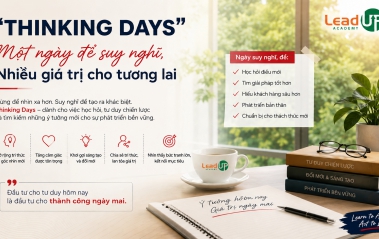
In many organizations today, most of employees’ and managers’ time is consumed by day-to-day operational activities: responding to emails, attending meetings, solving emerging issues, chasing project deadlines, and delivering KPIs.

In the context of digital transformation exerting a profound impact on the operating models of agencies and organizations, enhancing technological capability, digital mindset, and adaptability among public officials and civil servants has become an increasingly practical requirement. Beyond the mere use of tools, public administration units today need a workforce capable of working more effectively in digital environments, processing information more quickly, coordinating more efficiently, and serving citizens and organizations in a more convenient and transparent manner.

Steve Jobs is often regarded as a symbol of innovation and success in modern business history. However, according to Walter Isaacson’s analysis published in Harvard Business Review, the most valuable management lessons from Steve Jobs do not lie in his personal style or inspirational stories, but in the way he built an organization capable of generating innovation continuously and sustainably.
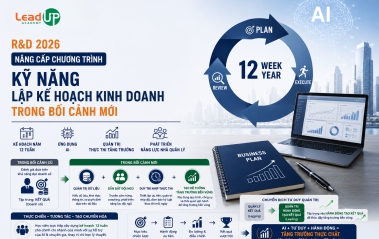
Markets are changing too rapidly. Customer behavior continues to shift. Pressure on revenue growth, customer retention, and competition is intensifying. Meanwhile, AI is beginning to directly impact how businesses analyze data, forecast growth, and manage team performance. As a result, the role of leadership teams and managers can no longer stop at merely “planning”; it must evolve into the capability of “managing growth execution,” especially at branch-level operations within service-oriented business organizations.

In the service industry, many organizations aspire to build a professional, consistent, and distinctive service culture. However, a considerable number of businesses still begin this journey through rigid regulations, imposed standards, or control mechanisms that place increasing pressure on employees, particularly frontline staff who interact directly with customers. While such approaches may create short-term compliance, they rarely generate genuine transformation in mindset, emotions, and service behavior from within.

In many service-oriented businesses, particularly within the hospitality industry, corporate culture development is often discussed as a long-term objective. However, the greatest gap does not lie in the willingness to change, but in the organization’s ability to transform cultural values into consistent daily operational behaviors.

In training and operational consulting projects, the greatest challenge does not lie in designing content, but in the ability to transform that content into tangible changes in behavior and customer experience. For this reason, Lead-UP Academy approaches each program not as a standalone training course, but as a continuous R&D loop, in which real-world data from learners and operations plays a central role in guiding adjustment decisions.
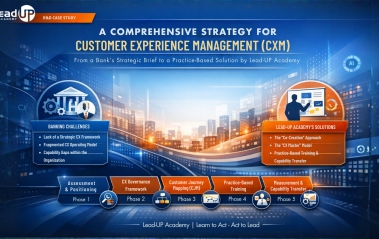
In the current period, the banking industry is witnessing a clear shift from competition based on products and interest rates toward competition driven by Customer Experience (CX). CX is no longer regarded as a supporting activity; it has become a core management capability that directly influences customer lifetime value, customer loyalty, and overall operational effectiveness.

A New Approach to Optimizing Marketing Operations for Enterprises in the New Context. Based on the strategic collaboration between Lead-UP Academy and Thai Thu Marketing, our R&D team has jointly conducted research and expanded Lead-UP’s solution ecosystem with an effective and optimized model: the Outsourced Marketing Department.
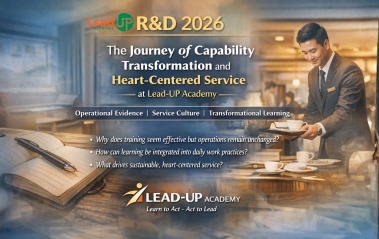
Over many years of delivering Learning & Development (L&D) programs for Vietnamese enterprises—particularly within service operations—Lead-UP Academy has consistently observed a recurring phenomenon: training programs are highly rated and widely shared, yet meaningful changes in day-to-day work practices emerge slowly and lack sustainability. Once a training program concludes and external experts withdraw, organizational behaviors often revert to their previous state.

In 2026, every bank already possesses clearly defined strategies and strategic directions. However, when examining these strategies closely, one critical aspect remains difficult to see clearly: organizational capability—the ability to translate strategy into consistent, day-to-day actions across every touchpoint.

This article is synthesized from the R&D initiatives of Lead-UP Academy and is intended for organizations seeking to transition from topic-based training to a systemic, capability-based development approach—one that is measurable, sustainable, and capable of generating real organizational transformation.
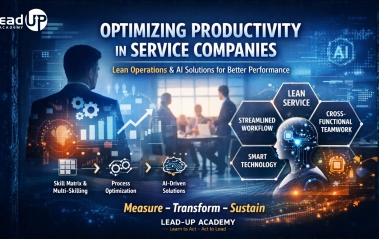
From Multi-Skilling Mindset to Lean Operations and AI Adoption. In the context where service companies are facing increasing pressure from rising operational costs, shortages of qualified talent, and ever-higher customer experience expectations, labor productivity has become a critical survival factor. However, productivity in service organizations cannot be improved merely by “working faster” or “pushing KPIs harder.”
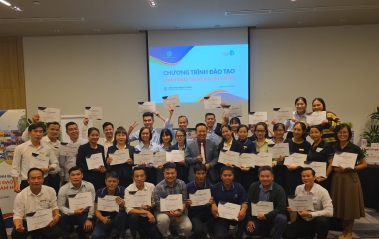
Vietnam’s Hospitality and Tourism sector is entering a fundamentally new stage of development. Recent recovery should no longer be interpreted merely as an effort to restore occupancy levels, but rather as a comprehensive challenge of enhancing operational standards, repositioning customer experience, and developing a sustainable workforce amid the following conditions...
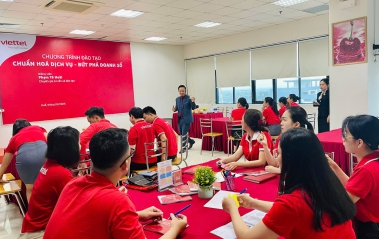
Over the past three years, the Telecommunications – Information & Communications Technology (ICT) industry has entered a phase of “mandatory restructuring.” The market is saturated, competition in data services is increasingly fierce, and customer behavior is changing faster than the speed of infrastructure upgrades. AI is disrupting how businesses operate. And notably, group–corporation structures are continuously merging, streamlining, and redesigning processes.
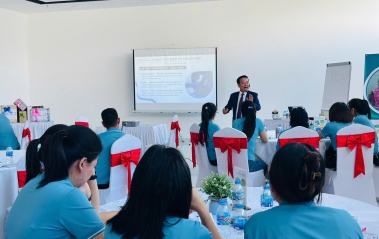
From practical research to an all-in-one, action-oriented training solution – designed to optimize resources, enhance capabilities, and build a leading workforce. In the context of lean operations and resource optimization, many organizations aspire to develop their workforce but lack a dedicated training department. In reality, most businesses assign training responsibilities to concurrent employees — resulting in programs that are often formalistic, insufficiently in-depth, and not aligned with the business strategy of each department.

In its ongoing journey to nurture genuine educational values, Sky-Line Education System continues to advance with a special training program designed exclusively for its Admissions Team, titled “Effective Admissions Consulting – Empathy, Commitment, and Companionship”, led by Expert Phạm Tô Hoài from the Lead-UP Academy for Practical Management.

The training program “Standardizing Service Mindset & Behavior – Managing Exceptional Customer Experience”, designed and delivered by Lead-UP Academy, has officially concluded with highly positive feedback and strong appreciation from both Hung Phat Real Estate’s Board of Directors and all participating learners.

At Lead-UP Academy, we have repeatedly observed a common reality during training sessions with service enterprises: each employee handles situations differently. Some are flexible and skillful; others rigidly follow SOPs, or even become confused and respond defensively. The result? Service quality becomes inconsistent, customer experiences lack uniformity, and businesses struggle to establish their own “standard” of service.

Over many years of delivering practical training, the experts at Lead-UP Academy have often witnessed the same scene: a quiet classroom, learners diligently listening and taking notes, yet lacking genuine excitement and active participation. We asked ourselves: How can we create a learning environment where participants not only listen, but truly engage, interact, and experience the classroom as something memorable?

In today’s era, where businesses are facing unprecedented disruptions – from digital transformation and global competition to the ever-increasing expectations of customers and employees – we believe training can no longer stop at simply “delivering knowledge” as it once did.