From topic-based training to capability development for addressing operational bottlenecks
In the context of 2026, Vietnamese enterprises are simultaneously facing several critical challenges: increasing pressure to optimize costs and improve productivity; workforce volatility, particularly within operational teams and middle management; and a widening gap between strategic intent and execution capability. Through its R&D activities and practical implementations across multiple industries—including banking, telecommunications, services, hospitality, real estate, and manufacturing—Lead-UP Academy presents in this article a clear and consistent message:
Training only creates value when it addresses the right operational “bottlenecks”—not when it merely expands the training course catalogue.
This article focuses on five key dimensions of corporate learning and development, as outlined below.
1. The Core Challenge of Contemporary L&D: High Training Investment, Low Behavioral Transformation
Based on field research and real-world implementation, Lead-UP Academy has identified a common paradox:
- Organizations invest substantial budgets in training;
- Employees participate fully and provide positive feedback;
- Yet operational performance after training remains largely unchanged.
The root cause does not lie in instructor quality or isolated content design, but rather in the L&D approach itself. Traditionally, many organizations have designed training around predefined topics, emphasizing knowledge and skill transfer and measuring success through participant satisfaction.
In contrast, a more appropriate approach for the current context is problem-driven L&D—one that standardizes managerial thinking, focuses on behavioral change, and evaluates effectiveness through measurable performance outcomes.
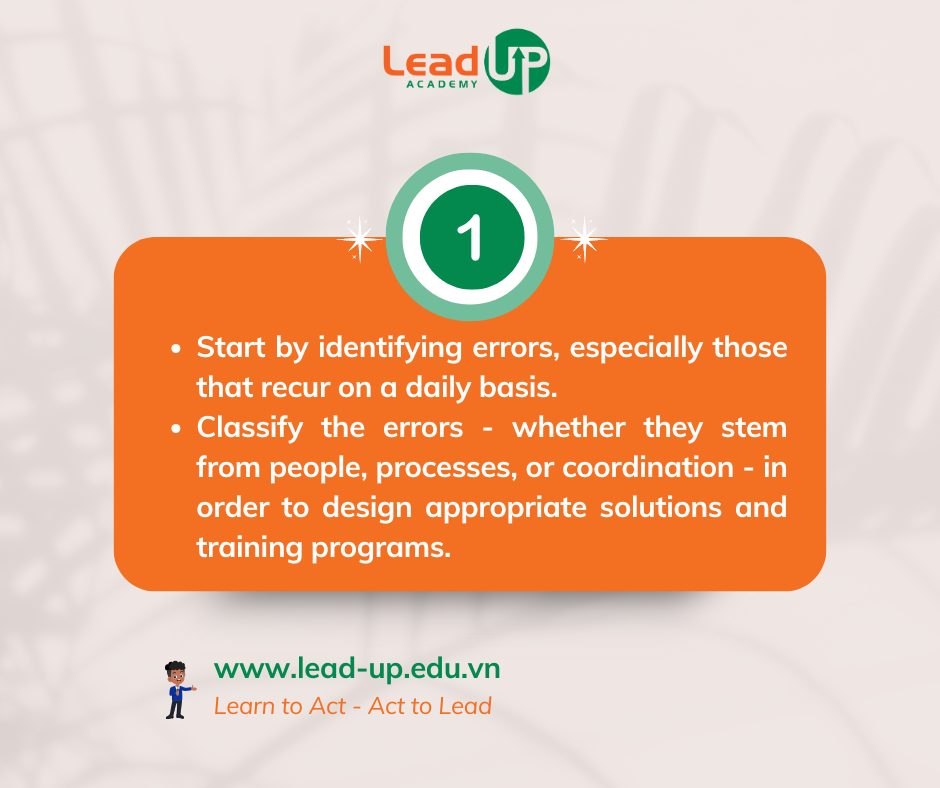
2. Operational Bottlenecks: Where L&D Should Begin
From an R&D perspective, Lead-UP Academy asserts that most performance issues do not stem from a lack of skills, but rather from:
- Small errors that recur on a daily basis;
- Lack of clarity in roles, processes, and cross-functional coordination;
- Misalignment between leadership expectations and employees’ actual behaviors.
Based on extensive consulting and training experience, Lead-UP Academy observes that common operational bottlenecks typically fall into four primary categories:
- People (mindset, attitude, execution capability);
- Processes and Technology (processes and systems exist but are inconsistently or incorrectly applied);
- Coordination (across departments and organizational levels);
- Management capability and organizational culture (monitoring, feedback, measurement, communication, discussion, and evaluation).
Training should only be initiated once an organization clearly identifies which category of bottleneck it is facing and determines whether the issue is sufficiently urgent to justify a transformation journey.
3. L&D Principles for 2026: Fewer – Right – Deeper
Drawing on its R&D insights, Lead-UP Academy proposes a new set of training design principles for 2026:
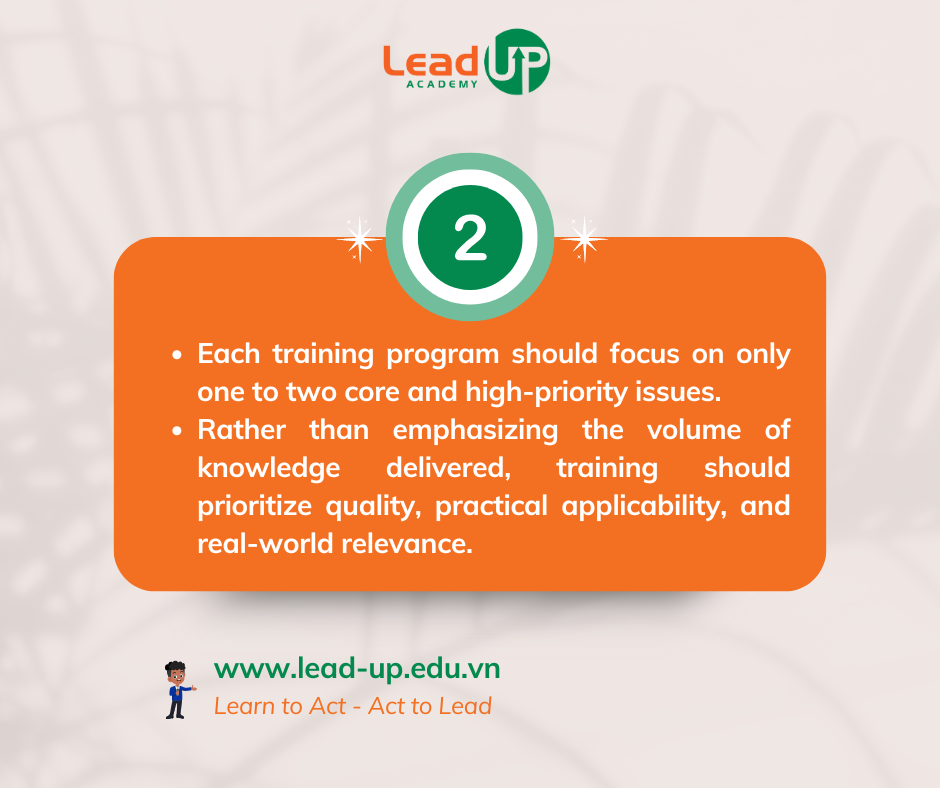
- Fewer: Each program should focus on only one to two critical issues; content should not be overly broad or overloaded.
- Right: Training content must originate from real operational problems; internal case studies should be prioritized.
- Deeper: Programs must drive behavioral change rather than stop at awareness; practical application, critical reflection, and clear action plans are essential.
4. Aligning L&D with Real KPIs, OKRs, and SLAs
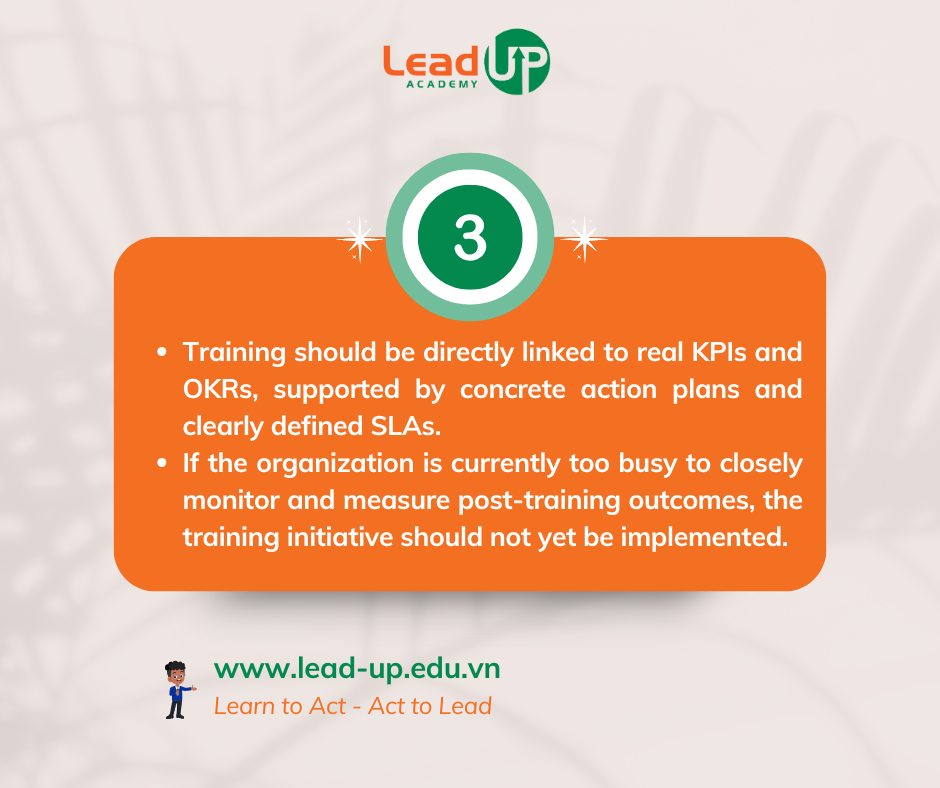
A key finding from Lead-UP Academy’s R&D activities is that if an organization lacks the capacity to monitor and measure post-training outcomes, it should not proceed with training.
In 2026, L&D must be designed as a deliberate operational intervention, in which:
- Each program is linked to specific KPIs or OKRs;
- Clear post-training action plans are established;
- SLAs are defined for follow-up and feedback.
Training is no longer a standalone activity, but an integral component of a performance management system that supports sustainable organizational growth.
5. From Classroom Delivery to Operational Leverage: The New Role of L&D and Middle Management
One of the most significant shifts in L&D for 2026 does not lie in training content, but in the role and mode of participation of L&D within the organizational operating system. Research findings and practical implementations by Lead-UP Academy demonstrate that when L&D is limited to organizing training sessions, designing curricula, and measuring participant satisfaction, its impact on operational performance remains minimal.
By contrast, organizations that achieve meaningful transformation share a common characteristic: L&D is repositioned as an operational leverage, rather than a purely support function.
Within this model, L&D is no longer the “classroom instructor” or training organizer, but instead becomes the function responsible for designing organizational capabilities and enabling learning mechanisms embedded in daily work. The focus shifts from knowledge delivery to the development of competency frameworks, standardization of on-the-job training tools (checklists, scenarios, OJT), and systematic monitoring of post-training behavioral transformation.
In parallel, the role of middle management undergoes a fundamental change. Rather than merely assigning tasks and supervising execution, middle managers become on-the-ground coaches, where learning occurs directly within daily operational workflows. It is in this environment that training content is activated, tested, and continuously refined through real-time feedback.
When L&D is integrated into operations in this manner, training is no longer perceived as a cost to be controlled, but as a measurable impact mechanism—reducing recurring errors, improving labor productivity, and narrowing the gap between strategy and execution. In other words, L&D 2026 does not operate alongside operations; it becomes an integral structural component of an effective operating system.
This transition requires organizations to fundamentally rethink training—not as a periodic activity, but as a continuous management lever through which human capability development progresses in parallel with operational optimization and strategic execution.
Conclusion
The ultimate value of training does not lie in the number of training sessions delivered, but in the tangible changes it brings to daily operational practices. Organizations that succeed in 2026 will not be those that train the most, but those that train correctly, execute swiftly, measure clearly, and institutionalize improvements.
This perspective forms the foundation for Lead-UP Academy’s continued development of tailored solutions for small and medium-sized enterprises in 2026, including:
- Bottleneck-driven L&D consulting;
- Practice-oriented training embedded in operations;
- Small-group coaching and OJT;
- Comprehensive “outsourced training department” solutions.
Respectfully,
---
Lead-UP Academy | Learn to Act – Act to Lead

 VI
VI EN
EN