The prevailing challenge in corporate training
Across many organizations, particularly small and medium-sized enterprises in Vietnam, learning and development initiatives are implemented on a regular basis. Annual training plans are established, budgets are allocated, and participation rates are generally high. Classroom engagement is often positive, and post-training evaluations frequently reflect high levels of satisfaction.
However, empirical observation reveals a persistent and critical gap. Despite substantial investment in training, day-to-day work practices often remain unchanged. Operational errors recur, productivity improvements are marginal, and expected performance gains fail to materialize. This discrepancy highlights a fundamental issue in contemporary L&D practice: training activity is frequently evaluated by its delivery quality rather than by its impact on work performance.
From a research and practice perspective, a clear conclusion emerges for L&D in 2026: learning that does not translate into improved performance constitutes organizational waste. If employees are unable to perform better the following day, the training intervention has not fulfilled its intended purpose and warrants reconsideration.

Reframing the fundamental question of L&D
Traditional training paradigms have long emphasized the accumulation of knowledge. Success has often been framed around questions such as what participants have learned or how much additional information they now possess. While such outcomes are not inherently irrelevant, they are insufficient as primary indicators of training effectiveness.
In the context of L&D 2026, a more appropriate and foundational question must be addressed: where, specifically, will performance improve tomorrow as a result of today’s training? This reframing represents a shift from knowledge acquisition to behavioral and performance transformation.
Effective learning interventions enable individuals to identify deficiencies in their current work practices, recognize concrete opportunities for improvement, and commit to altering their behavior within real operational contexts. Without this connection to daily work, training risks becoming an abstract exercise detached from organizational reality.
Core dimensions of effective L&D in 2026
- Asking the right questions
In an academic interpretation of L&D, training should be viewed as a deliberate intervention aimed at improving work performance rather than as an educational event. Programs must be designed to clarify what is not working, why it is not working, and how specific behaviors should change after the learning experience. When training fails to address these issues explicitly, its capacity to generate meaningful impact is severely limited.

- Designing for application
For learning to be applied, it must be embedded in the realities of organizational work. Research and field implementation consistently indicate that abstract examples and generalized case studies are far less effective than scenarios derived directly from an organization’s own operational challenges. Training design in 2026 therefore requires the integration of real workplace situations, immediate application exercises, and structured post-training support mechanisms.
Learning must be oriented toward resolving existing problems rather than expanding theoretical knowledge. When participants perceive a direct link between training content and their daily responsibilities, the likelihood of sustained behavioral change increases significantly.

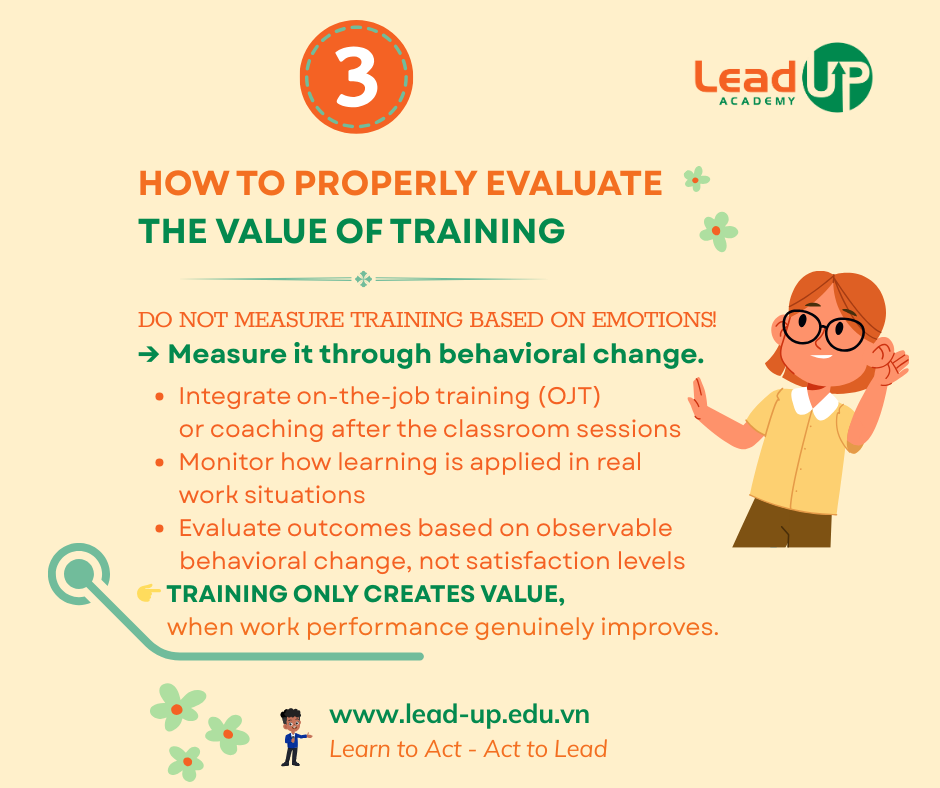
- Evaluating value through behavioral change
One of the most common methodological errors in training evaluation is the reliance on affective measures such as participant satisfaction or perceived enjoyment. While such measures may offer limited insights into engagement, they do not provide evidence of performance improvement.
A more rigorous evaluation framework for L&D in 2026 emphasizes observable behavioral change and measurable work outcomes. This includes tracking how newly acquired practices are implemented on the job, assessing improvements in task execution, and examining whether operational results improve following the intervention. Training demonstrates value only when it contributes to tangible improvements in how work is performed.
From training activities to operational leverage
An important conceptual shift in L&D 2026 is the repositioning of training within the broader operational system of the organization. Rather than functioning as a standalone activity, L&D increasingly serves as a mechanism for enhancing execution capability and supporting performance management.
This integration requires active involvement from line and middle managers, who play a critical role in reinforcing learning through coaching, feedback, and on-the-job guidance. It also requires organizations to invest time and effort in post-training follow-up and measurement. Without these elements, even well-designed programs struggle to produce lasting impact.
Organizations that succeed in this environment are not those that conduct the most training sessions, but those that align learning initiatives with real operational priorities, implement them swiftly, measure outcomes rigorously, and institutionalize effective practices.
Conclusion
L&D in 2026 is no longer defined by the volume of training delivered or the breadth of content covered. Its value lies in its capacity to influence how work is actually performed. Learning that fails to translate into improved practice represents a misallocation of organizational resources.
From an academic and applied perspective, the future of learning and development rests on a simple yet demanding principle: training must enable people to do their work better. Only then can L&D fulfill its role as a meaningful contributor to organizational effectiveness.
---
Lead-UP Academy | Learn to Act – Act to Lead

 VI
VI EN
EN